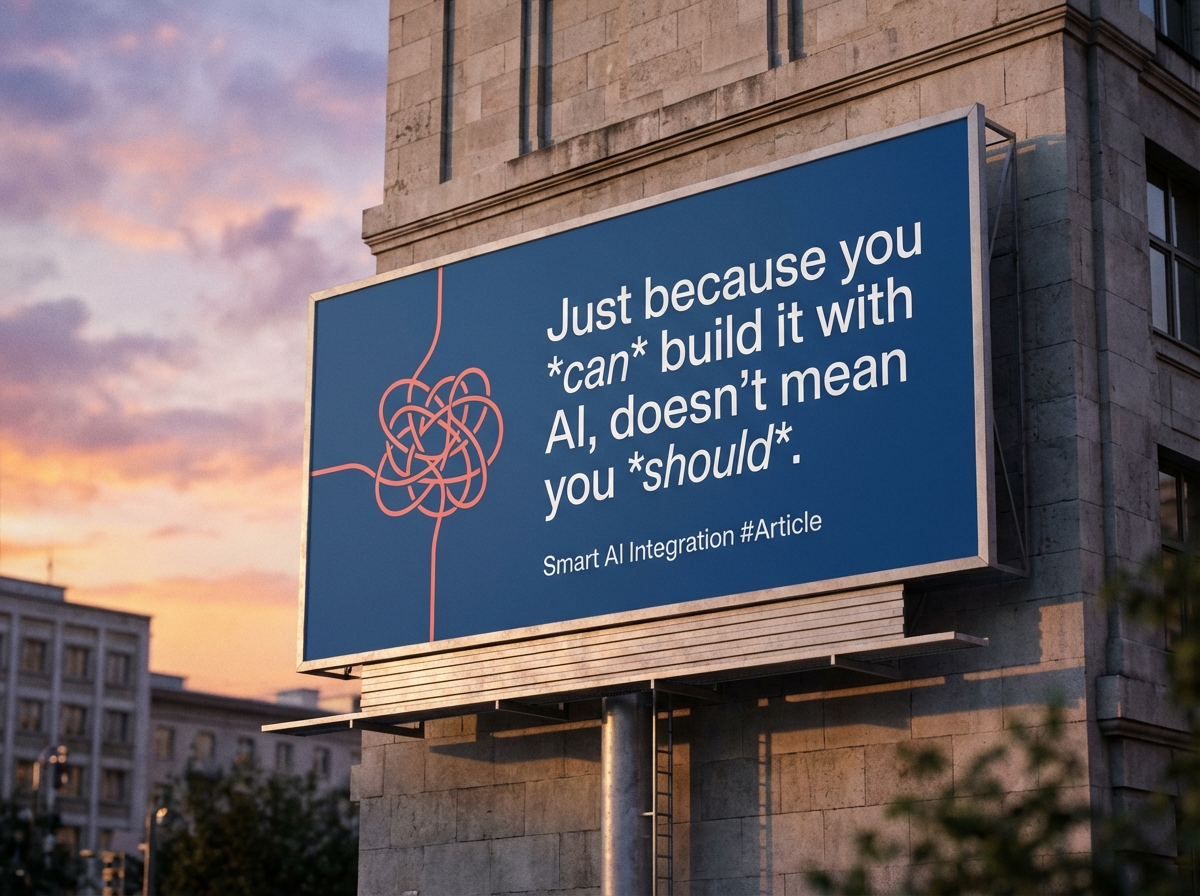
Your engineering team built a custom CRM in a weekend using AI. It's elegant. It's fast. It does exactly what you need. And in 18 months, it might be the thing that breaks your company.
I've watched this movie before. Multiple times.
A team gets excited about AI's capabilities. They build something bespoke—a CRM, an analytics dashboard, an internal tool. It works beautifully. Leadership celebrates the innovation. And then the company grows.
New products. New markets. New compliance requirements. Suddenly that elegant solution needs features nobody anticipated. The person who built it has moved on or been promoted. What started as a weekend project now requires a dedicated team just to keep it running.
This isn't an AI problem. It's a classic enterprise mistake—amplified by how easy AI has made it to build things.
The Seduction of Bespoke
The pitch is compelling: "Why pay for Salesforce when Claude can help us build exactly what we need?"
In the early days, it makes sense. A five-person startup doesn't need enterprise software designed for thousands of users. A streamlined tool built to your exact workflow can genuinely outperform an off-the-shelf solution. I'm not arguing against this.
I'm arguing against doing it without asking the hard question: What happens when we're 10x our current size?
I've seen analytics dashboards that started as brilliant innovations turn into full-time jobs—not because they stopped working, but because every team wanted their own version. Different definitions of "revenue." Different fiscal calendars. Different interpretations of the same data.
Suddenly you're not running a business. You're reconciling spreadsheets.
Shadow IT Is Back (And It's Wearing AI's Clothing)
Remember when every department had its own Access database? When Marketing's "customer list" and Sales' "prospect database" were completely different systems that somehow both claimed to be the source of truth?
We fixed that. It took years of painful ERP and CRM implementations, enterprise database and semantic models, but we fixed it.
AI is bringing it back—faster than ever.
When any team member can build a functional tool in an afternoon, the barrier to shadow IT drops to zero. And the problems compound:
- Data silos return with a vengeance
- Integration becomes impossible because nothing was built with integration in mind
- Key person risk skyrockets—the person who "just built a quick script" is now the only one who understands it
- Security and compliance get overlooked because "it's just an internal tool"
To resist the urge to build fast is hard. To take time to build solid foundational solutions for scale is hard.
When AI-Built Actually Makes Sense
I'm not saying never build. I'm saying build with intention.
Build when:
- The problem is genuinely unique to your business
- Off-the-shelf solutions require more customization than starting fresh
- You have engineering capacity to maintain it long-term
- The tool is disposable by design—a prototype, an experiment, a bridge to something better
Buy when:
- You're solving a problem thousands of other companies have solved
- Integration with other systems matters (it almost always does)
- You need the vendor to stay current with regulations, security, and features
- Your competitive advantage isn't in the tool itself—it's in how you use it
The irony? Most companies build when they should buy, and buy when they should build. They purchase enterprise AI platforms they don't need while their engineers recreate Jira in a weekend.
What SaaS Companies Should Actually Be Worried About
Here's a take that might surprise you: I'm not worried about AI killing SaaS.
Enterprises need scalability, security, compliance, and integration. They need vendors who will maintain the software when regulations change and who provide support when things break. A bespoke AI solution built by a team of three offers none of that.
What SaaS companies should be doing is embedding AI into their existing platforms—not panicking that customers will replace them. The smart ones already are.
The real risk for SaaS isn't AI-powered replacements. It's becoming commoditized by failing to add AI capabilities while competitors do.
The Strategic Question
Every AI initiative should start with this question:
"Is this a tool we want to be in the business of building and maintaining, or is this a distraction from what we actually do?"
If you're a fintech company, building AI-powered fraud detection might be core to your competitive advantage. Building an AI-powered expense tracker probably isn't.
If you're a services company, an AI tool that captures your unique methodology might be worth maintaining forever. An AI-built scheduling system is just undifferentiated infrastructure.
The goal isn't to use AI everywhere. It's to use AI where it creates sustainable value—and recognize when you're just creating future technical debt with a fancier interface.
The companies winning at AI adoption aren't the ones building the most. They're the ones asking the hardest questions about what to build, what to buy, and what to simply not do at all.
That's the discipline that scales.